


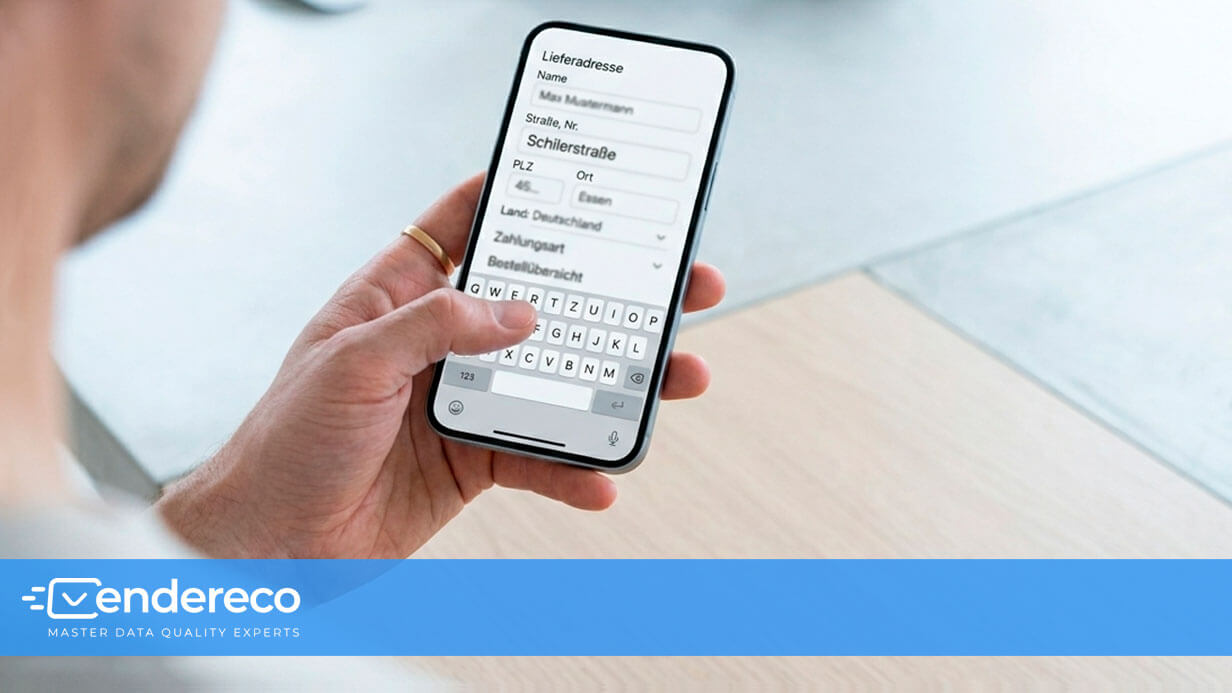
A smartphone display. A tiny address field. And your customer's thumb jumping back and forth between letters and numbers. „Schillerstrasse“ becomes „Schilerstrasse“. One letter is missing. The 24 becomes a 42. And the parcel? Off it goes. To an address that doesn't exist. A classic address error in the checkout.
Almost one in eleven addresses in online retail is incorrect
The Deutsche Post Direct Address Study 2025 has analyzed around 120 million customer addresses from 200 companies. With 91.3 percent deliverable addresses, online retail performed best in the industry. Sounds good at first. But it also means that 8.7 percent of customer addresses are incorrect. With 10,000 addresses, that would be around 870 in purely mathematical terms.
Many of these address errors occur directly when entering them in the checkout. A transposed number here, a letter swallowed there. Or autocorrect, which thinks it knows better.
What address errors really cost you
All right, one parcel is returned. Annoying, but no drama. Or is it?
Do the math. Shipping costs there. Shipping costs back. Then customer service gets in touch. The goods are checked, packed and stamped again. According to the EHI Retail Institute (2025 study) more than half of the retailers surveyed pay up to 10 euros per return. Almost 14 percent even pay up to 20 euros.
But what does not appear in any statistics: Your customer has ordered elsewhere in the meantime.
The conversion you paid for is gone. And the customer who might have become a regular customer? Instead, they leave a negative review. But not for the parcel service provider, but for you.
A single address error in the checkout that runs through the entire chain.
The blind spot in the checkout
About 70 percent of all shopping carts in German e-commerce are abandoned before a purchase is made. This is confirmed by the Half-year report 2025 from uptain. On mobile devices even around 80 percent.
The usual suspects are often the reason why customers drop out of the checkout: Shipping costs too high, payment method not included, registration annoying.
But one factor slips under the radar for most people: your address form.
Your customer types in five fields manually on their cell phone. And the form? It watches. Corrects nothing, suggests nothing, doesn't even notice when Leipzig and a Dresden zip code coincide.
There are budgets, A/B tests and entire teams for ads, landing pages and loading times. For the address form? Nothing. Your customer is free to type away. And you hope that it fits.
It's like a restaurant with a star chef where the front door is stuck.
The line on your bill that you never question
Parcel service providers such as DHL assign a routing code to each address. This determines which parcel center and delivery base are responsible. If DHL cannot assign a customer address automatically, an employee has to do it manually.
The so-called routing code fee at DHL is currently €0.49 net per shipment. Doesn't sound like much at first. But with hundreds of shipments per week, it quickly adds up.
And with DHL this is still comparatively cheap. The situation is similar with DPD: Shipping labels without correct barcode encoding cost Sendcloud surcharge overview 1.10 per shipment. If the address is so incorrect that the parcel cannot be delivered at all, there is a charge of over €7.
We regularly speak to retailers who are aware of these items on their invoice for the first time. And are surprised at how much they add up. You should check it out.
What an address entry assistant does differently
It catches what used to slip through: address errors in the checkout. Directly during entry, instead of afterwards in customer service.
Your customer types in „201″ and gets matching Hamburg zip codes suggested via autocomplete. One click and the location fills itself in. Entering „Sch“ is enough for Schillerstraße. Select the suggestion, done → And the address is correct.
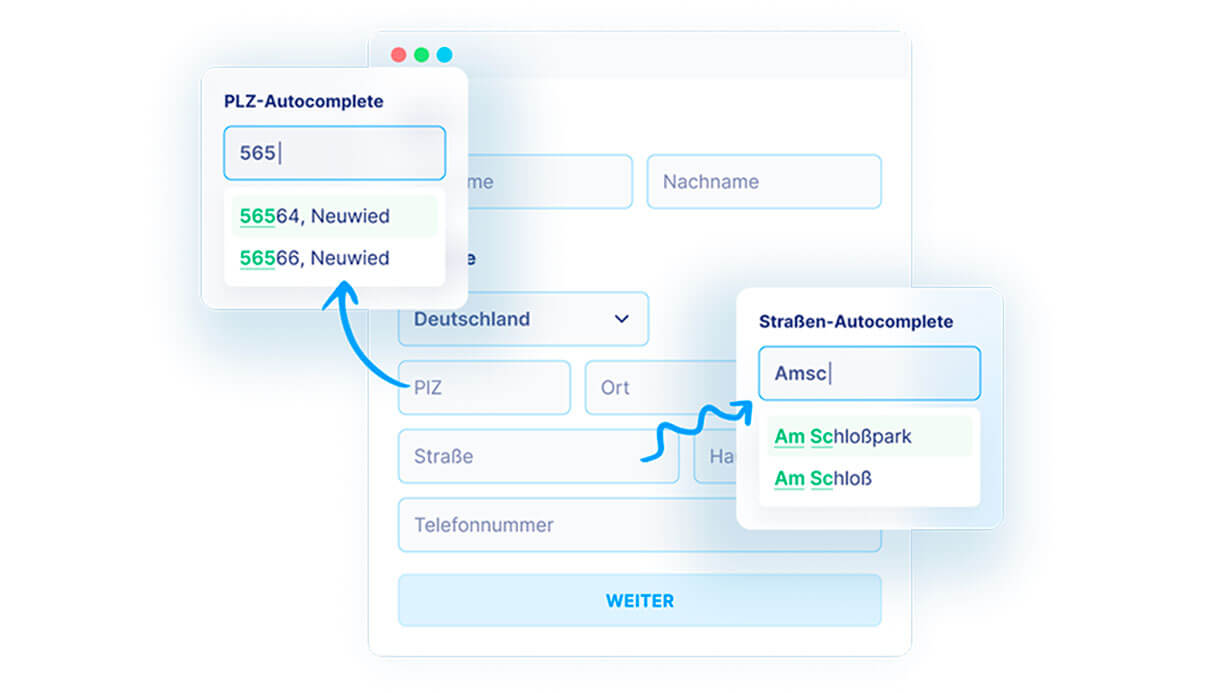
What happens in the background: endereco checks whether the zip code, town and street match each time a key is pressed. This is because the address completion function only suggests valid addresses. What does not exist does not even appear.
Those who order don't notice anything. You do: fewer queries in customer service.
Fewer parcels returned as undeliverable. And a routing code charge on the DHL invoice that is suddenly significantly lower.
For store systems such as Shopware, Shopify, OXID, JTL and other platforms there are ready-made plugins. All other systems can also be connected via API. There are also address suggestions for over 200 countries.
An endereco customer sums it up: „Since we started using Endereco, we have been able to reduce the number of addresses to be corrected by up to 90%. In particular, the many incorrect PayPal delivery addresses no longer delay the entire process from order receipt to goods issue.“
Address error in the checkout: Are you affected?
How many of your orders in the last three months had address corrections or were returned as undeliverable?
Does a routing code charge regularly appear on your DHL invoice?
And: What does your checkout look like on the smartphone when a customer enters an address?
If any of these questions give you pause for thought: That's exactly where we come in.
We will be happy to take a look at your checkout together in a free store analysis.
Where do customers get lost? Where do address errors creep in? And what can be improved immediately with little effort?