


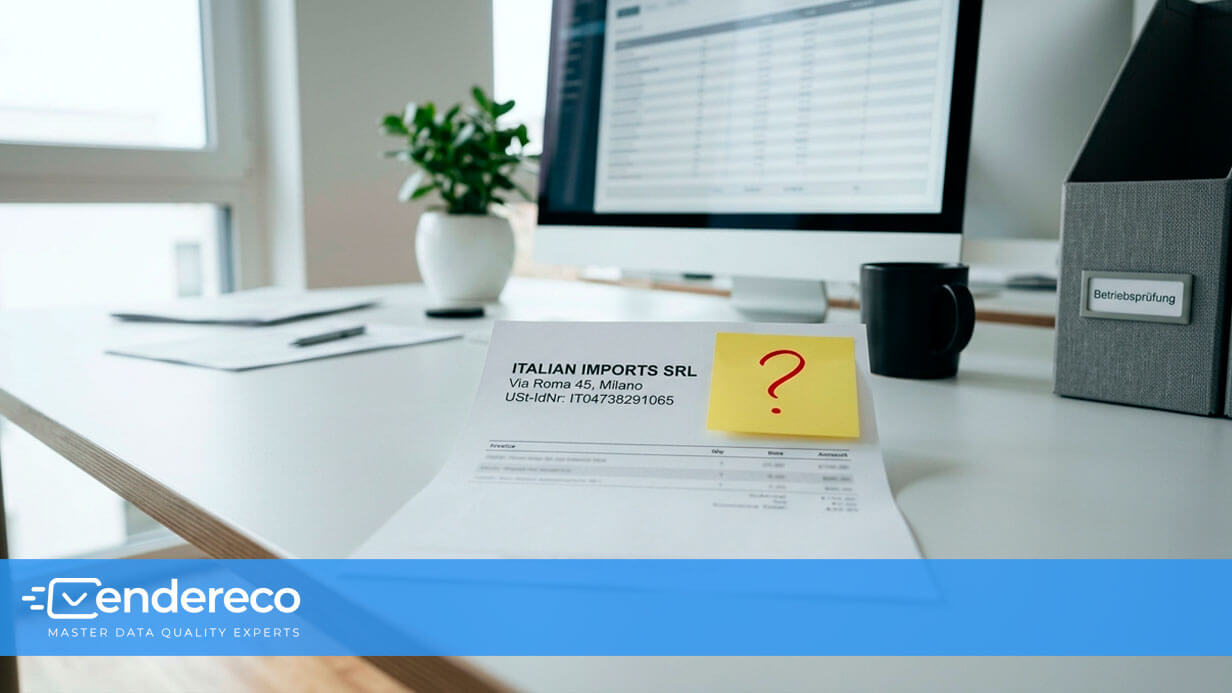
IT04738291065
At first glance, this VAT ID number looks perfectly fine. The country code is correct, and the format is correct. A retailer used it as provided by a customer in Milan and subsequently delivered goods worth 23,000 euros net, excluding VAT.
The problem: The number belonged to another company that had been removed from the commercial register three-quarters of a year earlier. However, the fraud wasn’t discovered until an audit was conducted. At that point, the retailer already owed the tax office 4,370 euros in sales tax plus interest on the back payments § 233a of the German Tax Code (AO). His customer in Milan had, of course, received the goods long ago. Try to collect the tax from him retroactively? That would likely be a lost cause.
Anyone selling B2B to other EU countries must verify their customer’s VAT ID at the time of each delivery and document the result. A simple confirmation is not sufficient for this purpose. The only legally compliant method is a qualified verification through the Federal Central Tax Office (BZSt), which also verifies the customer’s name, legal form, and address. If this proof is missing, the principle of protection of legitimate expectations under Section 6a(4) of the German Value-Added Tax Act (UStG) does not apply. And the tax office will collect the value-added tax from you.
Why You Need to Verify Every VAT ID
Since January 1, 2020, VAT ID verification has been mandatory for intra-Community supplies. Until then, you had several options for verifying your customer’s business status. With the EU Quick Fixes That is no longer the case.
The VAT ID must be valid at the time of delivery. If it is missing or invalid at that time, you will lose your tax exemption retroactively. And you will be responsible for paying the sales tax yourself.
You can read more about it in § 6a(1) of the Value-Added Tax Act (UStG) for the tax exemption and in § 18e of the Value-Added Tax Act (UStG) for the verification process at the Federal Central Tax Office.
What a missed exam could cost you
Back to the example. For 23,000 euros net, excluding VAT, the tax office is demanding an additional 4,370 euros. But that comes out of your pocket, not your customer's.
In addition, there is interest on back payments. The interest rate according to § 238 AO It currently stands at 1.8 percent per year. If the interest accrues over two years, that adds another 150 euros or so. With larger amounts or longer periods, it quickly becomes expensive.
And that's just one shipment. Anyone who regularly sells B2B to other EU countries and never conducts audits is taking on a risk. When the next audit comes around, all of that will come up at once.
In addition, if the VAT ID is incorrect, your summary report will also be invalid according to § 18a of the Value-Added Tax Act (UStG) incorrectly submitted to the BZSt.
What about the principle of protection of legitimate expectations? That comes into play when § 6a(4) of the Value-Added Tax Act (UStG) Only if you can prove that you exercised the due diligence of a prudent businessperson. Without documented verification, that will be difficult.
What Goes Wrong in Practice
The Milan example is not an isolated case. The causes may vary, but the result is always the same.
Here’s another example: Your customer provided you with their correct VAT ID when they placed their first order. When they ordered from you again two years later, you shipped the order without verifying the number again. After all, they’re a familiar customer. In the meantime, however, the tax authority in the country of origin had revoked the number because the company had been restructured. But the tax auditor didn’t discover this until months later. So at the time of the second shipment, the number had long since been invalid.
Errors in manual data entry are just as common. A customer gives their VAT ID over the phone, the employee types it into the CRM, and a digit gets mixed up. IT04738291065 becomes IT04738219065. The number has the correct format, so it doesn’t stand out at first glance. But it doesn’t belong to any registered company—or worse, it belongs to a different company.
Another classic mistake. You may check it, but you don't document the result. Later on, you won't be able to prove that the VAT ID was valid at the time of delivery. Without proof, there's no protection of legitimate expectations.
Added to this is a structural problem that isn't immediately apparent on the BZSt portal. The European Commission’s MIAS (VAT Information Exchange System), which powers the BZSt portal, is not a central database. It does, however, forward every request in real time to the national tax authority of the respective country. The European Commission But he himself writes the following:, ...that it cannot assume responsibility for the accuracy of the MIAS data because it comes from national databases to which it has no access. Changes to a VAT ID are not always immediately reflected in the national system and are therefore also visible in MIAS with a delay. For you, this means: A valid number may be reported as invalid, and an invalid number may still appear valid for a while. Both situations can occur.
Simple or qualified VAT ID verification?
When you verify a VAT ID, there are two options.
This simple check answers exactly one question: Does the number exist, and is it currently valid? That's all. So afterward, you won't know whether the number actually belongs to the company that's placing an order with you.
In a qualified audit, this is similar to Federal Central Tax Office (BZSt) the VAT ID, along with the company name, legal form, and address. To do this, it queries the databases of the respective EU member state and returns a result with a timestamp and reference number.
Only the qualified audit will have your back during a tax audit. The standard audit isn’t enough. So if you want to be on the safe side, go with the qualified one. Always.
What to Do If the Test Fails
If your customer’s VAT ID is invalid, you may not make a tax-exempt sale. Instead, you issue the invoice with sales tax and inform your customer that there is a problem with their VAT ID. The conversation is brief. A retroactive payment of 4,370 euros out of your own pocket, on the other hand, is not.
The situation is different if the thorough review reveals a discrepancy, such as in the name or address. In that case, ask your customer to have their information verified by the appropriate tax office. Only then should you make the tax-free delivery.
When and how often do you need to check?
The audit is not a one-time event related to a customer’s investment. Instead, the key factor is the date of delivery—not the date the order is placed, nor the date the invoice is issued. The VAT ID must be valid at the exact moment the goods are shipped. It may sound nitpicky, but that’s exactly what the tax auditor looks for.
You verify new customers before the first shipment. With regular customers, it’s more involved. That’s because the tax authority in the country of origin can revoke a VAT ID at any time—for example, if a company ceases operations or undergoes restructuring. So if you only check once a year, you’re flying blind for up to twelve months.
You'll be on the safe side if you check every delivery and document it.
VAT ID Also Relevant for Services
However, the VAT ID check is not limited to the trade in goods. Cross-border B2B services within the EU are just as affected.
When providing a service to a business in another EU country, you generally issue a net invoice, and your customer pays the sales tax in their country. This is known as the reverse-charge procedure. The prerequisite is that your customer is, in fact, a business. And this is verified through the VAT ID.
If it is missing or invalid, the tax office may question your client’s status as a business owner. The consequences depend on the specific case, but they are rarely minor. If in doubt, consult your tax advisor about the specific tax treatment. In any case, it remains your responsibility to verify the VAT ID.
Why Manual Verification Fails in Everyday Practice
While the check via the BZSt portal is free and straightforward for individual queries, that’s about all it is. You enter your own VAT ID, then your customer’s, and get a result. It takes two minutes per number.
But the portal has its limitations. That’s because batch queries aren’t possible via the online form. Instead, you have to enter each number individually and save the result. With 30, 50, or 100 B2B customers per month, this becomes a tedious task that eventually gets put aside. And honestly, who actually does this consistently?
Then there's the technical aspect. The BZSt itself points out on its Confirmation Page Please note that response times in the confirmation process are currently longer than usual. In the event of significant delays or timeouts, the agency recommends retrying the query at a different time of day. In addition, there is a daily maintenance window between 11:00 p.m. and 5:00 a.m., during which the verification process may be limited. Not all EU member states provide data of the same quality, and interruptions are not uncommon when querying data from other countries,
That leaves the documentation. According to the Principles of Proper Bookkeeping (GoBD), you must retain audit logs for ten years. And if you save the results as a screenshot on your desktop, you’ll run into trouble during the next tax audit. That’s because your records must be audit-proof. The tax office expects audit records to be retrievable at any time and not subject to subsequent alteration.
The requirement to conduct the audit exists, but the manual process via the BZSt portal is cumbersome. And for most people, the documentation involves more work than the audit itself.
How endereco Implements VAT ID Verification
With the endereco API You can automatically integrate the VAT ID check into your online store or ERP system. The verification is performed in real time against EU databases, and you can choose between a basic and a qualified check. The result is then documented in a legally compliant manner.
This works for all 27 EU member states and a total of 59 countries worldwide. Once connected, the verification runs in the background. That way, you no longer have to worry about the BZSt portal, yet you still have proof if the tax office asks for it.
Frequently Asked Questions About VAT ID Verification
Is the VAT ID check mandatory?
Yes. As of January 1, 2020, the customer’s valid VAT ID is a prerequisite for tax exemption on intra-Community supplies under Section 6a of the German Value-Added Tax Act (UStG). If the customer does not have a valid VAT ID at the time of delivery, you are liable for the value-added tax yourself.
Is a simple confirmation from the BZSt sufficient?
No. A simple verification only tells you whether the number exists and is currently valid. Only a qualified verification—which also verifies the company name, legal form, and address—is legally binding. In the event of a tax audit, only qualified verification counts.
How often do I need to verify the VAT ID of my existing customers?
Before every shipment. Tax authorities in the country of origin can revoke a VAT ID at any time, for example, if a business ceases operations or undergoes restructuring. If you only check once a year, you’ll be operating in the dark for up to twelve months.
What happens if my customer's VAT ID is invalid?
You are not allowed to ship tax-free. Issue the invoice with sales tax and inform your customer of the issue. If there is merely a discrepancy between the results of the official audit and the customer’s information (such as a change of address), ask the customer to clarify this with their tax office before you ship tax-free.
How long do I have to keep my test records?
Ten years, in accordance with the Principles of Proper Bookkeeping (GoBD). The filing system must be audit-proof. Screenshots on the desktop or PDFs in an email inbox are not sufficient because they can be altered retroactively. The tax office expects audit documents to be retrievable at any time and documented in a way that prevents alteration.
How are the VAT IDs in your database looking?
Do you know if your B2B customers' VAT IDs are currently valid? When was the last time you checked them? And would your documentation hold up during a tax audit?
We'd be happy to walk you through a quick demo to show you how the automated VAT ID verification can work in your system.
Arrange a personal meeting
Note: This article provides an overview of VAT ID verification in B2B e-commerce. It is not a substitute for tax or legal advice. For specific questions about your situation, please contact your tax advisor.