


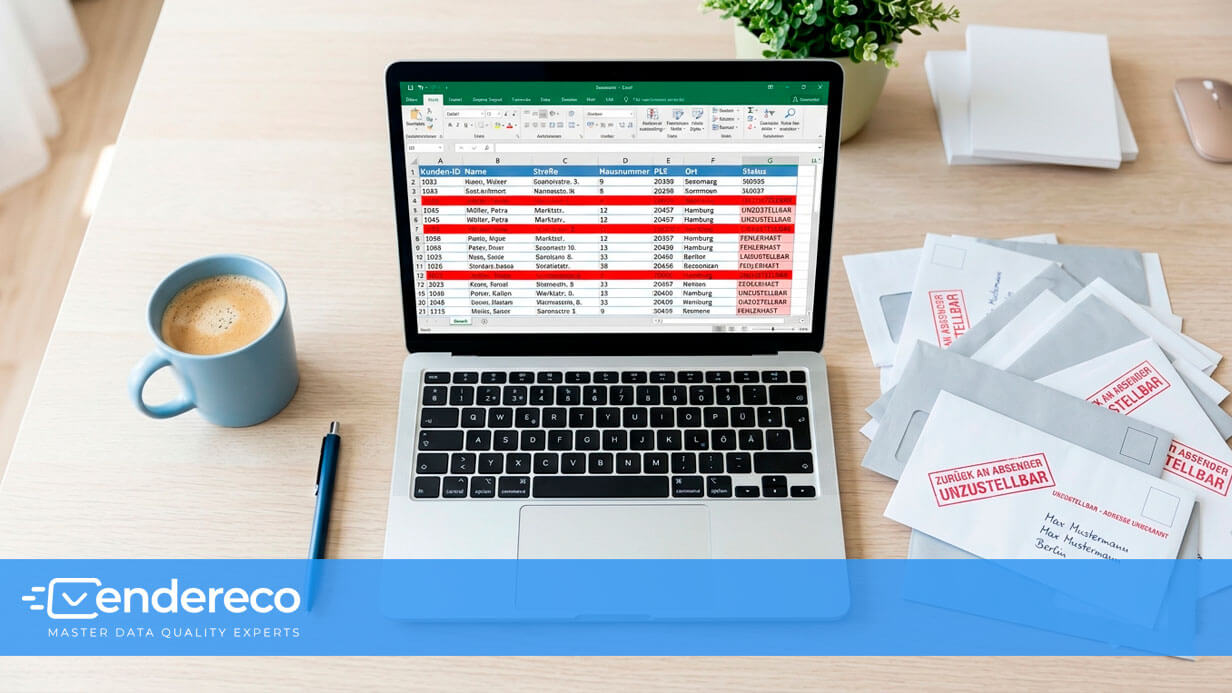
You send out 5,000 promotional letters to your customers. The offer is good, and the layout looks great. Three days later, 435 of them end up back on your desk. Recipients have moved.
435 customers you didn't reach. 435 instances of postage, printing, and handling for nothing.
Without address validation, the quality of your customer data will decline
When it comes to address quality, most retailers immediately think of typos at checkout. But that’s not where the bigger problem lies. The Deutsche Post Direct Address Study 2025 This paints a clear picture. Approximately 120 million customer addresses from 200 companies were analyzed. The result: 13.2 percent of all addresses held by German companies are incorrect. By comparison, two years earlier the figure was 12.6 percent.
Although online retail performs best in a cross-industry comparison, the overall percentage of incorrect addresses is still rising. And this is despite the fact that digital tools have been available for quite some time. That’s because customer data has an expiration date—and even the best tool can’t change that.
Typos aren't your biggest problem
Sure, typos when placing an order are, of course, a classic mistake.
A transposed digit in the ZIP code, a missing house number, and „Untr den Linden“ instead of „Unter den Linden.“.
Careless mistakes like these happen every day, especially on smartphones.
But typos are just one source of error—and often not the biggest one.
Addresses become outdated faster than you think
According to the same study, the most common cause of incorrect addresses is quite simple: the recipient has moved or passed away. This affects just under 6 out of every 100 addresses. For another 4 to 5 addresses per hundred, the information is outdated but can be corrected using change-of-address data.
But the study reveals even more: In 2024 alone, 350 place names and 5,700 street names were created, divided, or renamed in Germany. Eight million people moved. 360,000 got married, and 130,000 got divorced. Each of these changes affects at least one address.
Your customer database may be accurate today. In six months, however, it won't be anymore. But not because you did anything wrong—it's because the world outside keeps changing.
Other sources of error that are often overlooked
And then there are the errors that don't come from the customer at all. Your employee enters an address by hand, makes a typo in the street name, and just like that, the error is in the system. Probably no one notices it at first. Until three months later, when a mailing comes back, and you wonder why.
Data imports and migrations are also an issue. You switch e-commerce platforms or import customer data from another tool, and suddenly the ZIP code and city are stuck together in one field, house numbers are missing, and the formats no longer match.
Then there’s the classic problem when using multiple systems at the same time: Your CRM says „Hauptstraße 12,„ your online store says “Hauptstr. 12,” and your newsletter tool even still has the old address on file. Three systems, one customer, zero clarity. And you wonder why the email isn’t getting through.
What is address validation?
Address validation checks whether an entered or saved address actually exists.
Is this street in this town? Does the house number belong here? The system flags anything that's incorrect or corrects it right away.
The principle is simple: Enter the address, check it, and get the result.
So where do you implement this? Address validation isn't a single feature. It's more of a process that should be in place at various points throughout your company.
And now imagine all of this on an international scale
So far, we've been talking about German addresses: street, house number, ZIP code, city. A clear structure, fixed rules.
But as soon as you start selling internationally, things look different. Norway, for example, has rural addresses without traditional street names. Finnish towns often have two official names. Danish customers often prefer to use service points instead of their own address at checkout. And in the UK, postal codes determine delivery because they often cover only a few houses.
Every country has its own formats, rules, and pitfalls. What works in Germany might fail in Scandinavia or Southern Europe. Your German approach won't cut it there.
If you want to learn more about specific countries: In our News Blog Among other things, we have Norway, Denmark, Finland and Great Britain broken down in detail.
Where You Can Use Address Validation
Catch errors before they reach the system
The address is checked as soon as it's entered. If your customer enters a ZIP code that doesn't match the city, they'll see a notification right away. Or better yet: The Input Assistant suggests only valid addresses from the very beginning. This saves your customers time and you the hassle of returns.
Putting Inventory Data to the Test
You have 50,000 customer addresses in your database. How many of them are still current? With a bulk check, you can verify your entire database in one go. Whether an address has changed, a street has been renamed, or a house number doesn’t exist at all—you’ll catch all of these issues before the next mailing goes out.
This is especially relevant if you regularly send out mailings, print catalogs, or want to re-engage existing customers.
Check old data before it is transferred to the new system
Before you import 20,000 addresses from an old system into your new one, check them. This should go without saying. Yet very few people actually do it. And then you wonder why the return rate suddenly spikes after the relaunch.
How to Tell If Your Address Information Is a Problem
Very few retailers know the true state of their address quality. In fact, the problem often doesn't become apparent until the symptoms start to pile up.
Your return rate is rising, even though your product lineup hasn't changed. Customer service is seeing a growing number of tickets with the subject line „Package not received.“ Your billing statements regularly include additional fees for manual address matching. Or you send out a mailing, and the return rate suddenly hits double digits.
Taken individually, none of these signals seems dramatic. But when you look at them as a whole, a pattern emerges: Your address information is working against you, not for you.
Why don't you try it out? Grab your phone, open your own store, and enter an address.
Wrong ZIP code and no提示? No autocomplete? Well, congratulations. Because that's exactly what your customer sees, too.
The Specific Benefits of Address Validation
At first glance, data quality doesn't sound very exciting. But look at the flip side: returns, additional fees, and support tickets that could be avoided. That costs money—every month.
After all, every incorrect delivery results in a customer inquiry. And every customer inquiry ties up someone on your team who could be doing something more productive with that time.
In addition, there is the GDPR, which in Article Section 5, Paragraph 1 The General Data Protection Regulation clearly states that personal data must be up-to-date and accurate. Anyone with 30,000 addresses in their database, 4,000 of which are out of date, definitely has a delivery problem—one that will be noticed no later than the next data protection audit.
And then there's the point that makes the biggest difference in everyday life: You'll know exactly who you're sending what to. You can segment your audience effectively, avoid duplicates, and spend your money on campaigns instead of on returns.
How endereco implements this
During checkout, the Address check Every address entered is checked in real time. If the address doesn’t exist, your customer receives a notification. Errors that can be corrected are displayed immediately as suggestions. This works for over 200 countries and can be easily integrated into popular e-commerce platforms via a plugin or API. Once integrated, the entire process runs in the background. Your customers will simply notice that things suddenly go more smoothly. To see which systems we offer ready-made plugins for, check out our Integration Overview.
And for your inventory data, there's the Data Cleaning Service. It checks your entire address database in one go and updates outdated entries.
How are your address details?
Do you know how many of your customer addresses are still current? When was the last time you checked them? And how many mailings per month are returned as undeliverable?
In a free store analysis, we’d be happy to work with you to assess where your store stands in terms of address quality and identify the areas with the greatest potential for improvement. If you’d like to get a sense of it yourself first, we’ll walk you through a short demo showing how address validation works in your store’s system.